

Antique Trunk Identification: Hardware, Labels, Wood, and Fabric Clues
Practical guidance for antique trunk identification using visible hardware, labels, wood, and fabric clues. What photos can show and what they can’t.
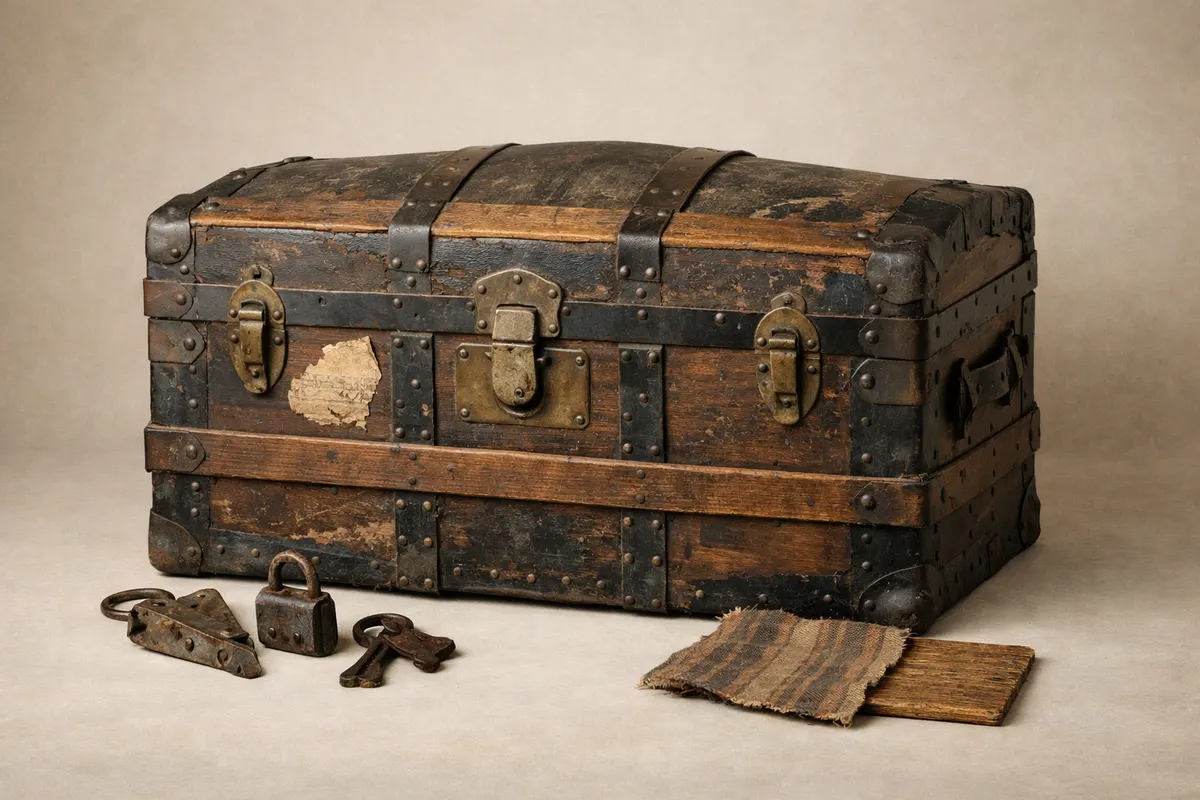
Quick answer for antique trunk identification
Antique trunk identification rests on a handful of visual clues that reliably survive a normal phone photo: hardware form and fastening, maker or travel labels, joinery and construction details, and lining materials. These clues rarely prove age or value by themselves, but together they narrow possibilities quickly.
Start by photographing locks, hinge pins, corner guards, and any paper or painted labels at close range. Hardware shape and how it's attached (rivet, screw, or nail) tells you more than patina alone: it indicates manufacturing technology and often a date range.
Treat every single-photo suggestion as provisional. A label, a distinctive cast corner, and a wood joint that all point the same way produce a useful working ID; any lone clue—color, a worn finish, or a copied logo—shouldn't be the basis for a definitive attribution.
- Most reliable photo clues: hardware type and fasteners, maker/travel labels, joinery or nailed construction, and lining/paper patterns.
- Combine at least three independent clues before assigning a likely era or maker.
- Single-photo identifications are research notes, not appraisals or authentication.
Strongest visual clues
Hardware form and how it’s attached is the top photo-friendly clue for antique trunk identification. Cast brass corners, stamped tin plates, riveted escutcheons, and hand-forged hinges each reflect specific manufacturing eras and processes. For example, early 19th-century hand-forged fastenings look different from mass-produced cast pieces of the late 1800s.
Maker and travel labels survive surprisingly well in photos. Paper labels pasted inside lids or under brims, steamer route stickers, and lithographed brand plates often include names, city locations, or patent dates that give a direct lead. Close, readable photos of these labels are high-value evidence—note legible words, typography, and any patent numbers.
Construction details—type of nails or screws, presence of dovetail or lap joints, and whether the trunk uses veneers or solid planks—help narrow dates and origins. Square-cut or rosehead nails and hand-cut dovetails suggest earlier construction; later trunks more commonly show machine-cut nails, slotted or early Phillips screws, and plywood or laminated boards.
Lining and interior materials are strong secondary clues. Printed paper liners, canvas, leather, and quilted fabric each have common date ranges and regional styles. For instance, lithographed floral paper liners and travel-route stickers are common on late 19th- and early 20th-century steamer trunks; simple canvas or cotton linings appear in later mass-produced trunks.
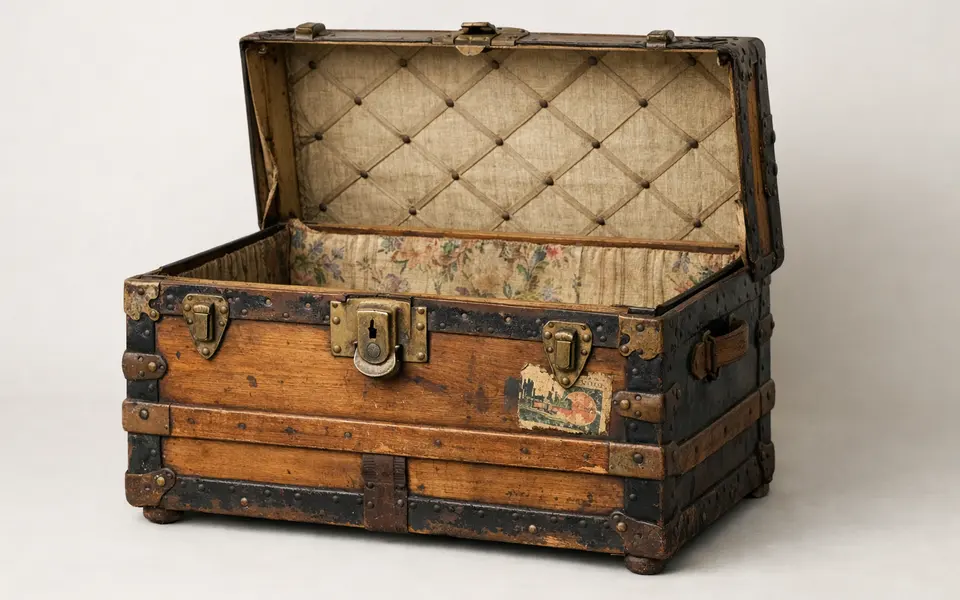
- Hardware shape + fastener type (rivet, machine screw, hand-forged nail) = manufacturing era indicator.
- Readable maker or steamer labels can provide maker name, city, and sometimes patent dates.
- Joinery and fasteners (dovetail, rosehead nails, slotted screws) narrow century and production method.
- Interior liners (printed paper, canvas, leather) suggest use and period: steamer trunks often have decorative paper liners.
Weak signals
Color and surface finish are often unreliable. Paint can be a later repaint, and darkened leather or wood can be the result of polishing, smoke, or a staged patina. Photographs can exaggerate or hide surface texture; don’t assign age or maker based on color alone.
Single-angle photos and low resolution create dangerous illusions. A corner piece photographed close-up might look hand-cast when it’s actually a modern casting with artificially aged edges. Glare and shadows obscure fastener heads, making modern screws look old or vice versa.
Generic styling is another weak signal. Many modern reproductions copy Victorian ornament or campaign-style hardware. A floral embossed plate or dome-top profile alone does not prove an antique origin. Look for manufacturing evidence—how the plate is attached, screw head style, and wear consistent with long-term use—before trusting style as proof.
- Do not rely on color, polish, or patina to date a trunk.
- One photo angle or a single decorative feature is a weak basis for identification.
- Modern reproductions may use copied hardware shapes—check attachment and tool marks.
Comparison workflow
Work top-down from the clearest, most objective clues. First, photograph and transcribe any text on labels and plates. Second, capture medium-close shots of locks, hinge pins, corners, and fasteners at 1:1 scale (fill the frame). Third, get wider shots showing overall shape, lid profile (flat, domed, hump), handles, and interior layout.
Use a simple matrix to compare likely matches: column headers for maker, hardware type, fastener type, lining, and unique marks; rows for each candidate trunk or reference image. Prefer matches that align in three or more columns. For example, if a candidate shares a stamped maker plate, riveted corners matching the same casting style, and a similar printed liner, it’s a stronger match than one that only shares the liner.
When you find conflicting clues—say a maker’s label but modern screws—consider repair or partial replacement as a hypothesis. Record which parts are original-looking and which appear replaced. That distinction is crucial: a later repair can make a trunk appear more modern while the case is older, or vice versa.
- Photo checklist: readable label, close hardware shots, fastener detail, full-profile shots, and interior liner close-ups.
- Create a comparison matrix and require at least three matching attributes for a working ID.
- Flag and document mismatches as potential repairs or replacements rather than dismissing the entire trunk.
App workflow
After you’ve checked visible clues, use Antique Identifier as a structured second pass. Start the session by uploading or scanning the photos you took following the comparison workflow: label close-ups, hardware detail shots, and full-profile images. Treat the app’s suggestions as leads to verify, not final judgments.
Use the app to surface possible maker names, similar hardware patterns, and documented label matches. When the app highlights potential matches, cross-check them against your matrix: do the suggested matches align with fastener type, joint style, and liner pattern? If they do, the suggestion becomes a stronger candidate; if not, treat it as a starting point for more research.
Always treat app outputs as research notes. If a suggested match implies high value or rarity, follow up with physical inspection by a qualified specialist—particularly for repair history, replaced hardware, or any claim about provenance or market value. The app accelerates initial sorting but cannot replace hands-on verification.
- Use the app only after collecting close-up and full-profile photos using the checklist.
- Cross-check app suggestions against hardware fasteners, joinery, and readable labels.
- If an app result implies notable value or rarity, seek in-person inspection to confirm provenance and condition.
Related guides
Try Antique Identifier as your next research step
After you’ve photographed labels, hardware, joints, and liners, use Antique Identifier to surface matching makers and similar examples. Treat results as research leads—cross-check any promising matches against the construction clues in this guide and get an in-person inspection before acting on value or provenance claims.
Take the next step →Frequently asked questions
How can I estimate the age of a trunk from photos?
Look for manufacturing clues: fastener and screw types, hinge and lock forms, and joinery. Hand-forged nails, rosehead nails, and hand-cut dovetails point to earlier 19th-century construction; machine-cut nails, stamped hardware, and slotted or machine screws suggest later 19th to early 20th century. Combine these with readable label dates or patent numbers if present.
Which hardware details are most telling in a photo?
Attachment method matters more than shape alone. Riveted or hand-forged attachments, visible tool marks, and cast corner patterns indicate older manufacturing processes. Also photograph screw heads: straight-slot older screws predate cross-head (Phillips) screws commonly used after the 1930s.
Can a single photo identify the maker or value of a trunk?
Rarely. A single photo may show a maker’s label that gives a clear lead, but even readable labels can be moved between trunks or replicated. Value, rarity, and authenticity require condition assessment, provenance, and often hands-on verification by an expert.
What’s the best way to photograph a trunk for identification?
Take multiple images: close-ups of any text or labels, detailed shots of locks/hinges/corners at perpendicular angles to reveal fastener heads, full-profile photos of the trunk from several sides, and interior liner close-ups. Include a small ruler or coin for scale and note any repairs or replaced parts in your notes.