

Van Briggle Pottery Marks: A Documented 1902 Example
Compare Van Briggle pottery marks with a documented 1902 vase from The Met. Learn how to photograph a base and check initials, dates, and inscriptions.
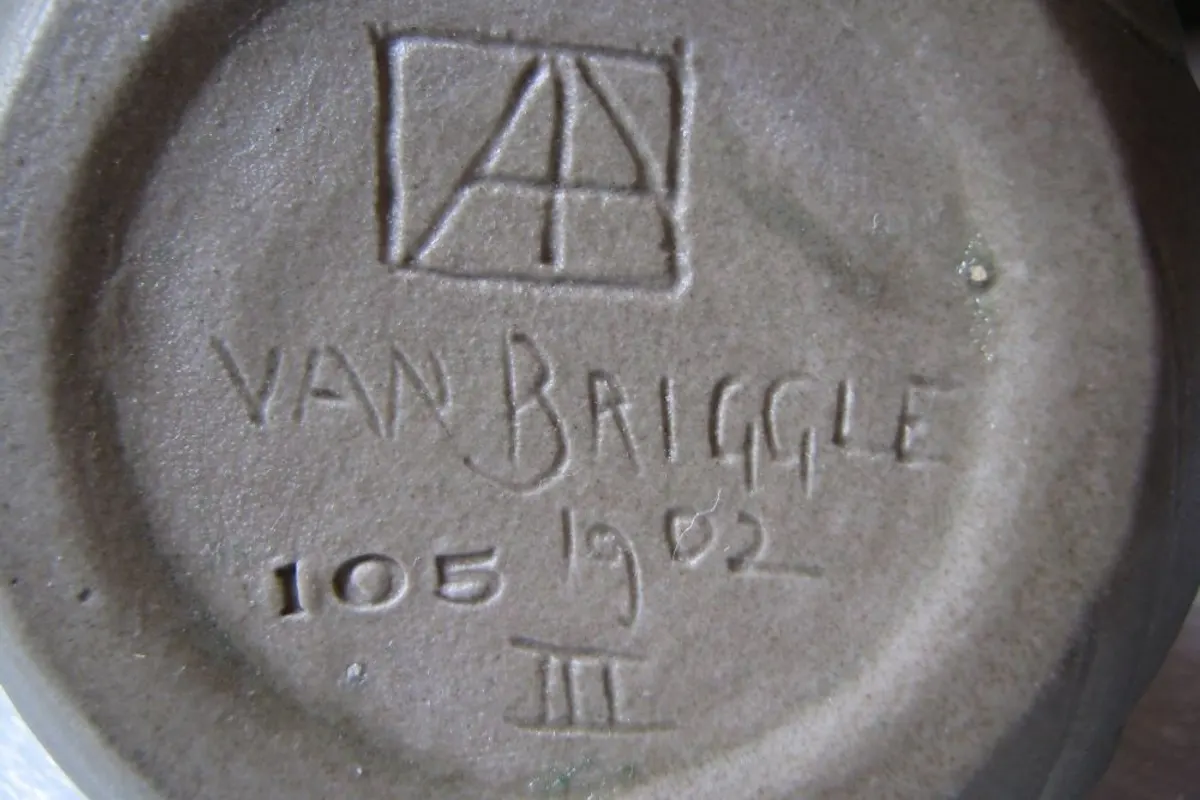
Quick answer: can a photo prove Van Briggle pottery marks?
On The Metropolitan Museum of Art’s 1902 earthenware vase, the base carries a boxed monogram, the Van Briggle name, the number 105, the year 1902 and a Roman numeral. The photograph above shows that specific vase. An object in your collection can share several of these features and still require independent identification.
Start by photographing the base and the mark at close range with scale and side views that include the object's context. If the mark matches licensed reference photos from museums or contemporary catalogues in shape and placement, you have a reasonable lead. However, you still need provenance, consistent body and glaze behavior, and (ideally) an expert or catalogue confirmation before treating the object as authenticated.
What Van Briggle pottery marks indicate and what they don’t
Artus Van Briggle established the Colorado Springs pottery with Anne Gregory Van Briggle in 1901. The Met attributes its 1902 vase, accession 2018.294.258, to Artus as maker and the Van Briggle Pottery Company as manufacturer. That distinction matters when transcribing a signature. The studio name can appear on a piece without identifying the person who finished it.
A photographed mark can indicate whether an object was intended to carry the Van Briggle name or motif, but marks were copied and reused by others, and some authentic pieces were re-marked or repaired. That means a matching mark is evidence, not definitive proof on its own.
Practically, use the mark photo to ask targeted follow-ups: is the mark in the expected location for the form? Does the surrounding clay and construction match known Van Briggle practice for the purported period? Do licensed museum photographs or published catalog entries show the same mark design? Those are the comparisons that increase confidence.
Van Briggle marks: the most reliable clues to check
First transcribe the letters, numbers and symbols exactly as they appear, leaving a blank for any unreadable character. On the museum vase the number 105 appears alongside 1902. Recording both numbers preserves the distinction between a literal inscription and an interpretation of what each number meant.
Look at the complete base and profile alongside the close-up. Record the foot shape, visible clay, surface finish and where the inscription sits. A photograph can show gloss, texture and color under particular lighting. A chemical analysis of the glaze requires a different kind of evidence.
When recording comparisons, name the reference object and accession number. An attributed museum object ties its photographs, measurements and object history together. Describe which features match and which differ before deciding what further evidence would support a date or attribution.
- Photograph the full base with a ruler for scale; include a close crop of the mark at high resolution.
- Capture the side profile and rim: form lines often match specific Van Briggle shapes.
- Record where the mark sits relative to the foot ring so another reader can compare the same area.
- Include a clear detail of decoration and glaze texture; these contextual details support a mark match.
- Check any small stamps or initials carefully—some collectors search for a specific v b pottery mark when comparing initials and spacing.
Step-by-step workflow
1) Photograph with intent. Take a straight-on, well-lit shot of the mark, a full-base shot with scale, and a profile image showing form and glaze transitions. If the mark sits inside a foot ring, include a side-lit close-up to show depth and tool marks. Avoid heavy reflection and shadow that hide incised details.
2) Assemble trustworthy references. Use licensed museum photographs, digitized catalogue plates, or published exhibition images as your primary comparators. Museum collections and established catalogues have documented chronological examples and variant marks that help place a design in a production period.
3) Compare systematically. Match placement, outline, and any internal lettering or decorative motifs. Note small but diagnostic differences like the spacing between letters, the presence or absence of an impressed border, or how high the mark sits relative to the foot ring. Record similarities and differences in writing or annotated images.
4) Use secondary checks. Look for consistent manufacture clues (throwing or molding marks), glaze behavior, and condition consistent with expected age. If photographic evidence and reference matches remain ambiguous, consult a specialist or the catalogue records listed by museums before assuming authenticity.
- Label and timestamp every photo you take; a short sequence of photos improves the evidence chain.
- If possible, identify a licensed reference photo (museum or catalogue) that shows the same mark and save that citation.
- Keep a log of who you consulted and what they said; provenance notes are part of the verification record.
Examples
For a documented comparison, open the museum record at https://www.metmuseum.org/art/collection/search/19967 and compare the whole vase with the base photograph. The museum lists the height as 9.2 centimeters and the material as earthenware. Those details give you a scale and a material to record alongside the inscription. On a second vase, a similar monogram is one observation among several.
Scenario B — A painted or copied mark on a mismatched body: Photos sometimes reveal a painted logo applied later or a stamped mark that sits on clay that differs from known Van Briggle body textures. In these cases the mark is a caution sign; you should treat the piece as a lookalike until further evidence appears (provenance, purchase receipts, or lab analysis).
Scenario C — Partial or worn marks: Wear can hide diagnostic elements. If the mark is incomplete in the photo, attempt alternate lighting and a raking-light shot to reveal incised lines. If that still leaves gaps, seek a comparative image showing the same mark type and document which features are missing so an expert can assess whether the wear pattern is plausible for an original mark.
- If you find matches in a museum collection image, save the museum accession number or catalogue citation when possible.
- When a mark appears repainted or added, photograph any paint edges or differences in pigment under magnification.
Limitations
Photos are powerful but limited. A photo cannot reliably prove provenance, chain of ownership, or whether a mark was added later without a hands-on inspection. Certain features—internal clay composition, microscopic tool marks, or subtle restoration—require physical examination and sometimes lab analysis.
Do not assume that a visible match means authenticity. Copies and well-executed lookalikes exist, and some marks were intentionally reproduced by others. When faced with a borderline case, a photo-based opinion should be treated as provisional until a trusted catalogue, museum accession catalogue, or a qualified specialist confirms the identification.
Watch out for deliberate forgeries: they can be convincing in photos, especially when a forger has access to a genuine mark image to mimic. That is why using licensed museum photos and catalogue plates for comparison is essential: they provide a verified visual standard instead of random internet images.
Finally, beware of the online temptation to declare final value or authenticity from a single snapshot. If your goal is to sell, insure, or donate, plan for a professional appraisal or authentication step after your photo-based research.
- A photo alone cannot prove long-form provenance or legal title.
- Some questions about composition, restoration or age require a specialist to examine the piece in person.
- If you suspect deliberate alteration or forgery, pause and seek a specialist rather than relying on crowd-sourced opinions.
- Photos are a first pass: use the site's Pottery Marks Identification resource and museum catalogues for the next verification step.
Related guides
Take the next step with reference checks and tools
Save one photograph of the full base and one of the whole vessel. Use the pottery mark identifier at https://antiqueidentifierbypicture.app/tools/pottery-mark-identifier for a first reading, then check any proposed maker against a documented collection object. For a valuable piece, ask a ceramics specialist to examine it before relying on an attribution.
Take the next step →Frequently asked questions
How can I tell if my vase has fake Van Briggle marks?
Start by photographing the mark and base as directed in this guide and compare that image to licensed museum photographs or catalogue plates. Look for inconsistencies in mark placement, letter spacing, and how the mark sits in the clay. If the mark looks superficially similar but the surrounding body, glaze, or construction doesn't match documented Van Briggle examples, treat the mark with suspicion. When in doubt, gather provenance documents and consult a qualified ceramics specialist or museum curator who can examine the piece in hand.
Where can I find verified Van Briggle marks examples to compare with my photos?
The Metropolitan Museum of Art publishes photographs and catalog details for a 1902 Colorado Springs vase, accession 2018.294.258. Start with the full object and its base mark at https://www.metmuseum.org/art/collection/search/19967. Keep its accession number with your notes and look for additional catalogued pieces when comparing other dates and forms.
Does a 'v b pottery mark' always mean the piece is Van Briggle?
No. Some initials or abbreviated marks can appear on pieces from different makers or be later additions. Treat a v b pottery mark as a clue, not proof. Compare the mark's exact style and placement to museum examples, and check the object's construction, glaze, and any provenance. If the initials are the only evidence, seek further verification before accepting a Van Briggle attribution.
Can I rely on an app or online forum identification from a photo alone?
Apps and online communities can provide helpful first impressions and point to likely matches, but they should be used as one part of a verification chain. A photo-based result is provisional: it helps you narrow possibilities and decide which catalogue or museum reference to consult next. For formal authentication, valuation, or legal purposes, you will usually need a documented appraisal or a hands-on specialist review.