

Antique Clock Makers: Dial, Case, Movement Clues
Learn which visual details help identify antique clock makers, what clues are reliable, and the sensible next steps before treating one photo as proof.
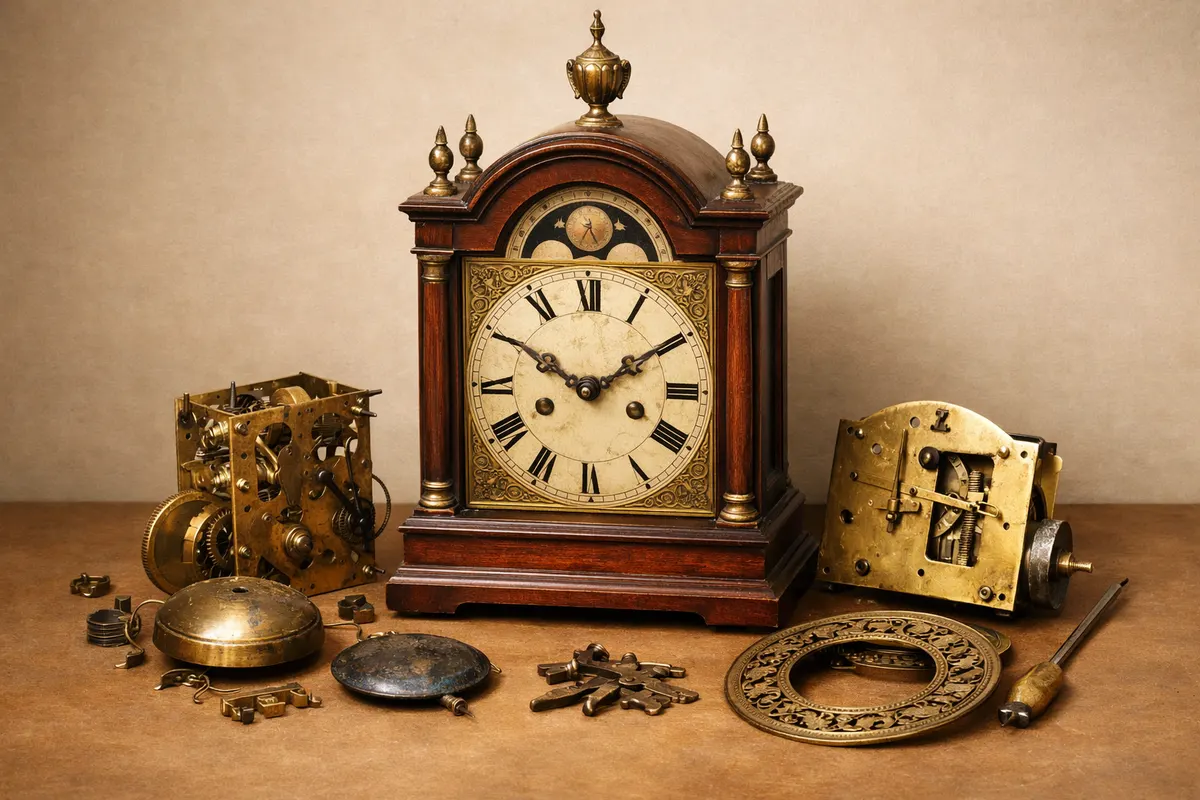
Quick answer for antique clock makers identification
When a single photo is all you have, the clearest evidence for antique clock makers is usually maker names and dates stamped on the movement plate, an original paper or printed label inside the case, and consistent construction details between dial, movement, and case. A signed dial or an engraved movement plate that matches a maker’s known style gives a strong lead, but it is rarely absolute proof on its own.
Wear patterns, repair marks, and replacement parts change the visual story. A later-signed dial, refitted movement, or modern screws in the case can make a genuine period case look like a later or different maker’s work. Always treat every single visible clue as part of a combined picture rather than a final verdict.
Reasonable expectations: photos can reliably tell you whether a clock has period hardware, a maker stamp on the movement, a factory label, or typical case joinery. They are poor at proving provenance, exact year, or market value without corroborating documentation or an in-person inspection.
Next steps after your initial photo check: record close-up images of the dial signature, movement plate, case interior (including labels), and any maker stamps; then compare those details to trustworthy references or use a research tool as a first pass. If identification still matters, follow up with a conservator or specialist for hands-on verification.
Most reliable visual clues for antique clock makers
The most durable, comparison-ready clues survive ordinary lighting and a normal phone photo. Start with text and marks: movement-plate engravings, stamped maker names, patent dates, and serial numbers are high-value. These marks are often on brass plates, arbors, the back of the movement, or the inside of the case door and can be matched to period catalogues or maker indices.
Case construction details — joinery, hinge types, nail and screw head finishes, and veneer patterns — are also strong signals. For example, dovetailed drawer joinery or hand-cut Tenon-and-mortise framing points to an earlier hand-made case; consistent machine-cut, uniform screws and stamped hinges indicate later factory work or restoration.
Dial and hand construction tell different parts of the story. Painted iron dials with visible retouching or replaced numeral cartouches suggest restoration; brass dials with engraved maker names or applied silvered chapter rings are less likely to have been swapped casually. If the dial signature, movement engraving, and case label all name the same maker or town, that congruence raises confidence.
Paper or printed labels inside the case are very helpful if intact and legible; they often include retailer names, addresses, or patent notices you can check in period directories. Conversely, faded or partially removed labels can still show typographic or paper-fiber clues that a conservator or paper specialist can date.
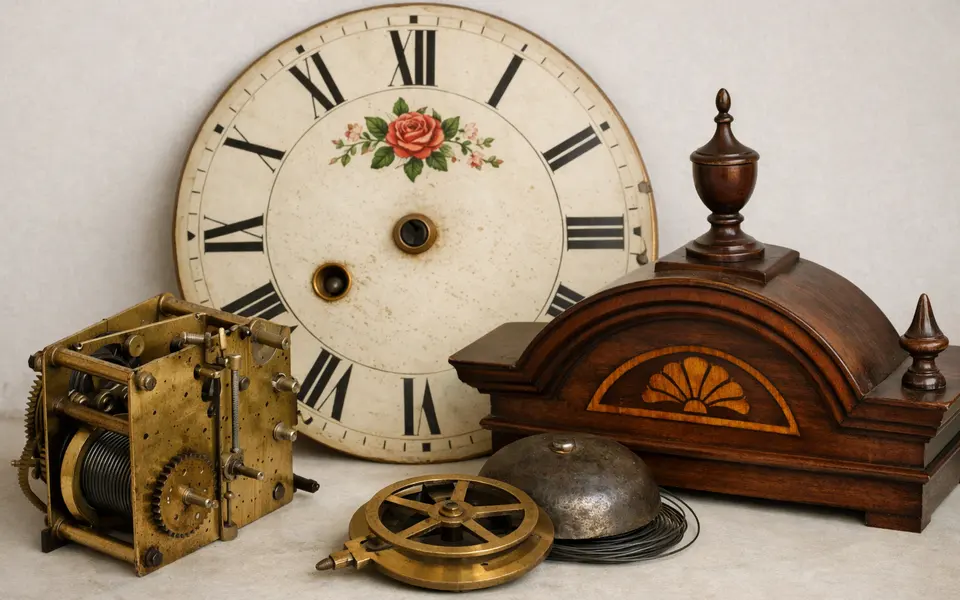
- Look for movement stamps on the back plate — maker name, town, and patent dates are prime clues.
- Photograph the inside of the case door and the movement from multiple angles to catch hidden labels and screws.
- Note joinery: dovetails, hand-cut pins, and pegged tenons suggest older, hand-made cases.
- Record the dial close-up: engraved names, transfer prints, and applied numerals survive better than surface paint.
- antique clock makers clues: check movement plates and paper labels first, then confirm with case construction.
Weak signals
Some details look informative but are unreliable by themselves. Finish color, decorative carving style, or a general silhouette can be mimicked by later makers or modern reproduction workshops. A varnish color that appears 'old' in a photo might be an applied stain or an artist’s distressing job rather than natural patina.
Hands, glass, and applied hardware are frequently replaced and therefore poor single-item evidence. A brass or steel hand pattern can help narrow possibilities when combined with movement and case clues, but the same hand design can be fitted by different retailers and repairers over many decades.
Watch for obvious restoration signs that break identification signals: modern Phillips-head screws, epoxy fills at joins, laminated veneers glued over old surfaces, and painted-over or reprinted labels. These alterations can conceal maker information or create false matches. Take several photos under different light so that shadows or glare don’t hide repairs.
Beware of stylistic similarity across regions. For example, many American shelf clocks from the mid-19th century share painted tablet scenes and similar case profiles produced by multiple firms; a lookalike case is not proof of a single maker. Contextual evidence — provenance, invoice, or a retailer’s label that matches the movement — matters more than silhouette alone.
- Color and surface patina can be misleading when cleaning or restoration has altered the finish.
- Hands, dial faces, and glasses are commonly replaced and should not be used as sole proof.
- Later hardware or modern screws are red flags for alterations that weaken visual evidence.
- Similar decorative motifs across makers create lookalikes; match multiple clue types before concluding.
Comparison workflow
A reliable comparison combines several independent clues. First, collect consistent, well-lit photos: full-case front and back, close-ups of the movement plate (both sides), the dial signature area, any labels inside the door or on the backboard, and details of joinery and screws. Use these images to build a short evidence packet you can compare side-by-side with reference examples.
Next, match textual evidence before stylistic evidence. If a movement bears a stamped maker name and a patent date, search trade directories, patent records, and maker catalogues for that name and period. If literature shows the maker operated in the same town and produced similar movement layouts, that strengthens the match beyond a silhouette comparison.
Then compare construction details: movement architecture (count wheels, type of escapement, pendulum suspension), case joinery, and label typography. Consistent combinations—such as a specific maker’s movement plate shape matched with a known case builder’s hinge type—are more convincing than any single trait. Note repairs and replacements that could have introduced mismatches.
Finally, record a confidence level and next actions: low confidence needs more photos or an in-hand check; medium confidence suggests consulting a specialist or auction records; high confidence still benefits from corroborating documents like invoices or provenance.
| Clue | What to record | How to compare | Typical confidence |
|---|---|---|---|
| Movement stamp | Maker name, patent date, serial | Search maker directories and patent records | High |
| Dial signature | Engraving style, location, transfer marks | Match engraving style to known examples | Medium–High |
| Case joinery | Dovetails, pinned tenons, hinge type | Compare to period construction guides | Medium |
| Paper label | Printer type, address, typography | Check retailer and printer references | Medium–High |
| Escapement & pendulum | Anchor type, suspension method, bob | Match to maker movement types | Medium |
| Hands & glass | Shape, mounting method, glass type | Use only as supporting clues | Low–Medium |
- Photograph: full case, movement (both sides), dial close-up, inside labels, and screw/hinge details.
- Text first: match maker names, serial numbers, and patent dates to period references.
- Construction second: compare joinery, movement layout, and escapement type.
- Context third: check retailer labels, provenance, and period directories before concluding.
Use Antique Identifier after your visual checklist
Treat the app as a research tool that helps you organize and compare the images and clues you’ve already gathered. Before using any app, make sure you have close-up photos of the movement plate, the dial signature area, the inside of the case with any paper label, and at least one full-case image. Those four image types are the minimum that let an identification tool make a useful first-pass comparison.
When you consult a tool like Antique Identifier, present it with the full set of photos and note the clues you found: maker names, patent dates, serial numbers, and unusual construction details. Use the app's suggestions as hypotheses to test, not as final certification. If the app highlights possible makers, follow up by checking the movement details against published maker plates or trade directory entries.
If the suggested match is uncertain, consider these conservative next steps: seek out period catalog illustrations, check local historical society directories for the retailer names on paper labels, or compare your evidence to documented examples in specialist publications. For maker-stamp questions you can also consult resources such as Antique Doll Marks when reading maker stamps and printed labels to understand stamp placement and typographic clues.
Finally, remember the app cannot replace hands-on inspection when the question is authenticity or monetary value. Use Antique Identifier to narrow candidates and assemble a clear set of photos and notes you can show to a conservator, seller, or auction house if professional verification is required.
- Prepare: movement plate, dial close-up, full-case shot, inside label photo before using the tool.
- Use app results as hypotheses—verify with maker directories or period catalogues.
- If uncertain, pursue provenance documents or a specialist in hands-on inspection.
- Visit the Antique Identifier tool page for the first-pass research step: https://antiqueidentifierbypicture.app/tools/antique-identifier
Related guides
After checking visible clues, try a focused first pass with Antique Identifier
Once you’ve photographed the dial signature, movement plate, case interior with any label, and a full-case view, use Antique Identifier as a structured first pass to organize possibilities and surface matching examples. Treat its suggestions as research leads—use them to target period catalogues, patent records, or specialist references rather than as definitive proof. If you want a place to start, visit the Antique Identifier research tool at https://antiqueidentifierbypicture.app/tools/antique-identifier to get a photo-based starting point and next-step guidance, then compare any suggested maker with independent records.
Take the next step →Frequently asked questions
How can I tell if a dial signature is original or a later addition?
Look closely for consistent wear, paint layering, and how the signature integrates with the dial surface. An original signature that aged with the dial will show the same craquelure, dirt accumulation, and retouching patterns as nearby numerals. If the ink or paint sits on top of later varnish or shows sharply different aging, it may be a later addition. Also check the movement and case: if the movement plate or case label names a different maker, that inconsistency raises the chance the dial was replaced.
What antique clock makers examples should I compare when identifying a mantel or shelf clock?
Compare known examples from the same period and region: look for similar movement plate outlines, signature placement, dial material, and case joinery. For American shelf clocks, compare the movement mounting style and label typography; for English mantel clocks, examine the escapement type and maker-stamp conventions. Use period catalogues and museum records as references and focus on matched combinations—movement plus case details—rather than silhouette alone.
Can serial numbers or patent dates on a movement give a reliable manufacture date?
Patent dates provide a useful terminus post quem (earliest possible date) but not a precise manufacture year because patent notices were often used for many years. Serial numbers can be helpful when the maker’s records survive and are published; some firms kept serial logs, others did not. Treat serial numbers as a piece of the puzzle: they are more informative when combined with patent dates, known production runs, and documented retailer invoices or catalog illustrations.
When should I consult a conservator or specialist for maker identification?
If the clock may be valuable, if an identification affects conservation decisions, or if you find altered or removed labels, consult a specialist. A conservator can examine joinery, adhesives, paper fibers, and metal patina in ways a photo cannot, and a specialist can access trade directories and maker archives. Use a conservator for delicate labels or fragile cases that should not be handled aggressively during photography.