

Antique Doll Marks: How to Read Maker Stamps and Visible Clues
Learn which antique doll marks a photo can show, which clues are reliable, and the practical next checks to narrow maker and date without overclaiming.
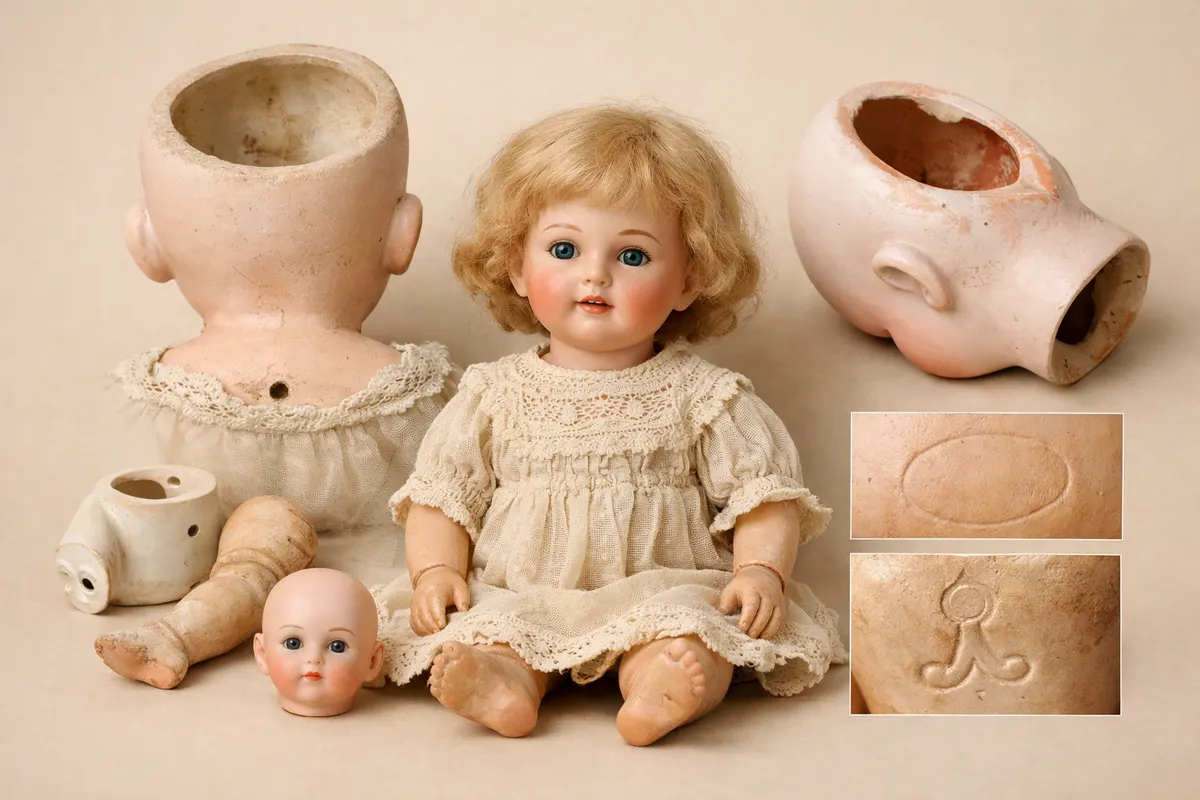
Quick answer: what antique doll marks can tell you
Antique doll marks can provide a maker name, country wording or a number to research. Start by copying the complete inscription, including line breaks and symbols, then compare it with a documented doll. A number by itself is not an exact date, and a mark on a head does not establish the history of the entire doll.
Keep three questions separate: what does the mark actually say, which documented object has a comparable mark, and what evidence connects your doll to that example? A readable inscription may answer the first question while the other two remain uncertain. Do not fill an unclear letter from a search result and then treat the guessed reading as evidence.
Photograph the whole doll and any already accessible mark before making changes. Keep notes about inherited information, receipts or older photographs separately from your own observations. Those records may help a specialist assess an attribution, but family recollections and visual resemblance should still be identified as such.
Read the complete mark: a documented Armand Marseille example
The Maryland Archaeological Conservation Laboratory records a bisque socket head bearing the inscription “Made in Germany/390/A 1 1/2 M” and attributes it to Armand Marseille. Its catalog connects the 390 designation with a jointed composition doll. This gives you a specific recorded object to compare, rather than a free-floating number from a seller listing. See the museum artifact record (https://apps.jefpat.maryland.gov/diagnostic/Home/IndividualCard.aspx?OBJID=4937).
A second reference, National Trust object 660888, records the name Armand Marseille, Germany, 390 and an A.6.M. marking on the neck of a bisque-headed doll with a composition body. The collection leaves the date unknown. That is a useful reminder that a maker attribution and an exact production date are different claims. Consult the National Trust catalog entry (https://www.nationaltrustcollections.org.uk/object/660888).
For your own notes, put the visible wording in one column and your interpretation in another. Preserve uncertain characters as question marks. Compare the position and arrangement of the inscription alongside the object description; do not assume that any doll with 390 visible must be the same age, in the same condition or made from the same original components.
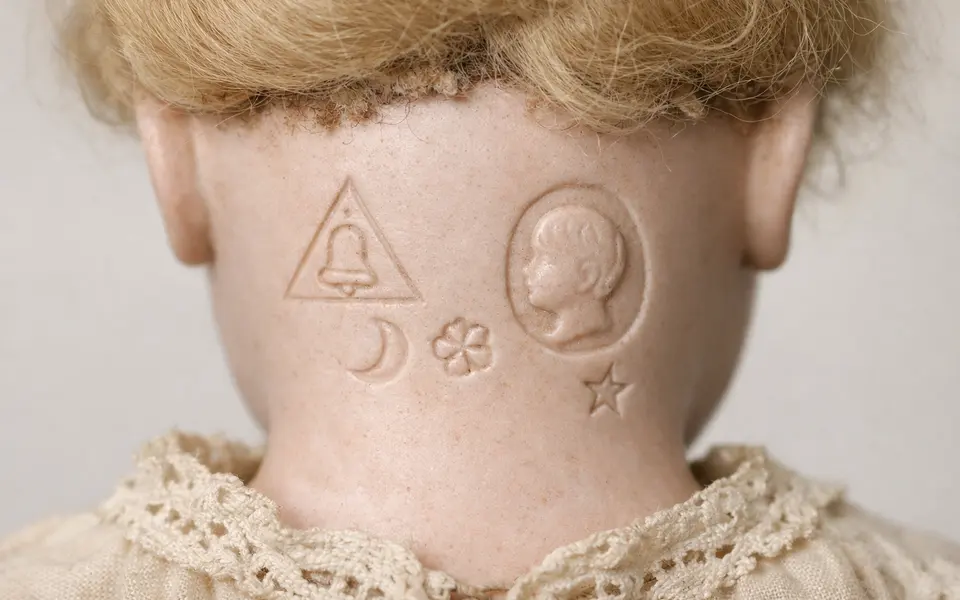
- Record names and initials exactly as visible, without expanding an uncertain abbreviation.
- Copy country wording, numbers, punctuation and line breaks separately.
- Note whether the mark is impressed, painted, printed or on an attached label.
- Save the reference URL and collection number with your comparison notes.
- Use the linked collection photographs for real examples; this page’s generated illustrations are not a maker-mark key.
Materials, clothing and wear: supporting clues with limits
Describe what the photograph shows before naming the material. A matte-looking surface, a glossy finish or visible cracks can be recorded, but lighting and coatings affect their appearance. Avoid describing an unidentified head as bisque, composition or celluloid with certainty solely because its color resembles a reference image. Leave the material provisional if the available view cannot settle it.
Record the visible head-to-body connection, limb joints and eye appearance without moving a mechanism to test it. These details help compare the object with a catalog description. A shoulder head is not automatically metal, and a particular joint is not a universal factory or country signature. Do not apply a simple French-versus-German construction rule across all dolls.
Keep clothing and labels in the record, but do not assume they were supplied with the doll. A garment may have been changed, repaired or added later. Hand stitching does not by itself prove an early date, and machine stitching does not by itself prove a modern reproduction. If a label conflicts with a head mark, record both observations and leave the relationship unresolved.
Wear and an old-fashioned face are also limited clues. Fading, damage or a fresh-looking repair cannot establish when the entire object was made. If two parts appear different, photograph the contrast without calling it fraud: later repair, replacement and a mistaken initial reading are all possibilities that require evidence.
- Separate visible surface observations from an unconfirmed material identification.
- Record accessible construction details without forcing joints or opening the head.
- Treat clothing, wigs and labels as components whose history needs checking.
- Do not infer an exact date or authenticity from wear, stitching or a partial number.
Photograph a worn mark without altering the doll
Use an overview image to show where the mark sits and a close-up for the characters. Keep the camera steady, use diffuse light, then change the light angle to see whether a shallow impression becomes clearer. Retain the original photo alongside any cropped version. Avoid filters or AI enhancement that could invent a missing line or digit.
Do not rub graphite over a mark, chalk or ink an impression, scrape a surface, wet a label, or clean the doll to make lettering clearer. Leave glued wigs, fragile clothing and covered marks in place. Photograph existing damage only if it is already accessible; never make a chip or lift paint to identify a material.
The Canadian Conservation Institute recommends examining an object’s condition before handling and minimizing movement of fragile objects. If paint is flaking, fabric is tearing or a part is loose, stop repositioning it for photographs and ask a conservator about safe examination. See its heritage-object handling guidance (https://www.canada.ca/en/conservation-institute/services/preventive-conservation/guidelines-collections/handling-heritage-objects.html).
Build a short comparison record with the inscription, accessible construction details, source links and unresolved questions. There is no reliable rule that three matching clues authenticate a doll. The quality and independence of the evidence matter; several observations copied from one uncertain listing do not become separate confirmations.
- Take an overview and a focused close-up without changing the object.
- Record uncertain letters as uncertain, then compare documented inscriptions.
- List both similarities and differences against each candidate reference.
- Stop when obtaining another view would require disassembly or stress a fragile part.
- Bring the photographs and unanswered questions to a doll specialist when an attribution matters.
Use Antique Identifier to organize the next research step
The free Antique Identifier web tool accepts one photo and returns a first-pass interpretation of visible item, material, style and mark clues. Choose the clearest relevant image. Keep your other angles and written notes for your own comparison or for a specialist; the web uploader is not a multi-photo research packet.
A suggested maker or period is a lead to check. Compare any reported letters with the original photograph and ask whether the result explains which visible details support its suggestion. If a mark is blurred or hidden, the appropriate next step may be to leave the identification open rather than repeat an attractive but unsupported attribution.
The tool does not authenticate a doll, guarantee a production date, or provide a certified appraisal. For an intended sale, insurance record or potentially important attribution, consult a specialist who can examine the object and supporting documentation. Keep condition assessment and value questions separate from simply reading the mark.
For another example of separating marks from their interpretation, see our Antique Silver Marks guide (https://antiqueidentifierbypicture.app/blog/antique-silver-marks). Its silver-specific symbols do not apply to dolls, but the habit of transcribing first and checking a documented reference is useful across a collection.
Related guides
Check visible doll clues with Antique Identifier
Upload one clear photo to Antique Identifier (https://antiqueidentifierbypicture.app/tools/antique-identifier) for a preliminary description of visible clues and details to research next. Check any suggested reading against your original image and documented references; the result cannot authenticate a doll or establish its value.
Take the next step →Frequently asked questions
Does a number on an antique doll mark give its date?
Do not read an isolated number as a year without a reference that explains it. A number may be part of a model, mold or size designation. Record the entire inscription and compare the actual object with a catalog entry. A documented maker attribution can still leave the production date unknown.
How can I read a worn or partial doll stamp?
Take an overview and a close-up, then change the lighting angle while keeping the doll supported. Record uncertain characters with question marks. Do not rub, chalk, scrape or wet the surface to improve the reading. Leave inaccessible marks covered if reaching them would disturb a wig, garment or fragile part.
Can a clothing label confirm the maker of the doll?
A label documents the garment or component on which it appears, but its connection to the rest of the doll needs checking. Clothing may have been replaced. Record any conflict between a label and a head mark rather than choosing whichever gives the more desirable attribution.
Are the illustrations on this page real antique doll marks?
No. They are AI-generated illustrations with invented details, not authenticated objects or reference marks. Use the linked museum collection records for documented examples. Do not identify a maker by matching the symbols in these illustrations.