

Antique Pocket Knife Identification: Tang Stamps Guide
Learn what photos can reveal about antique pocket knife identification, from tang stamps to construction, and which checks you need before relying on one image.
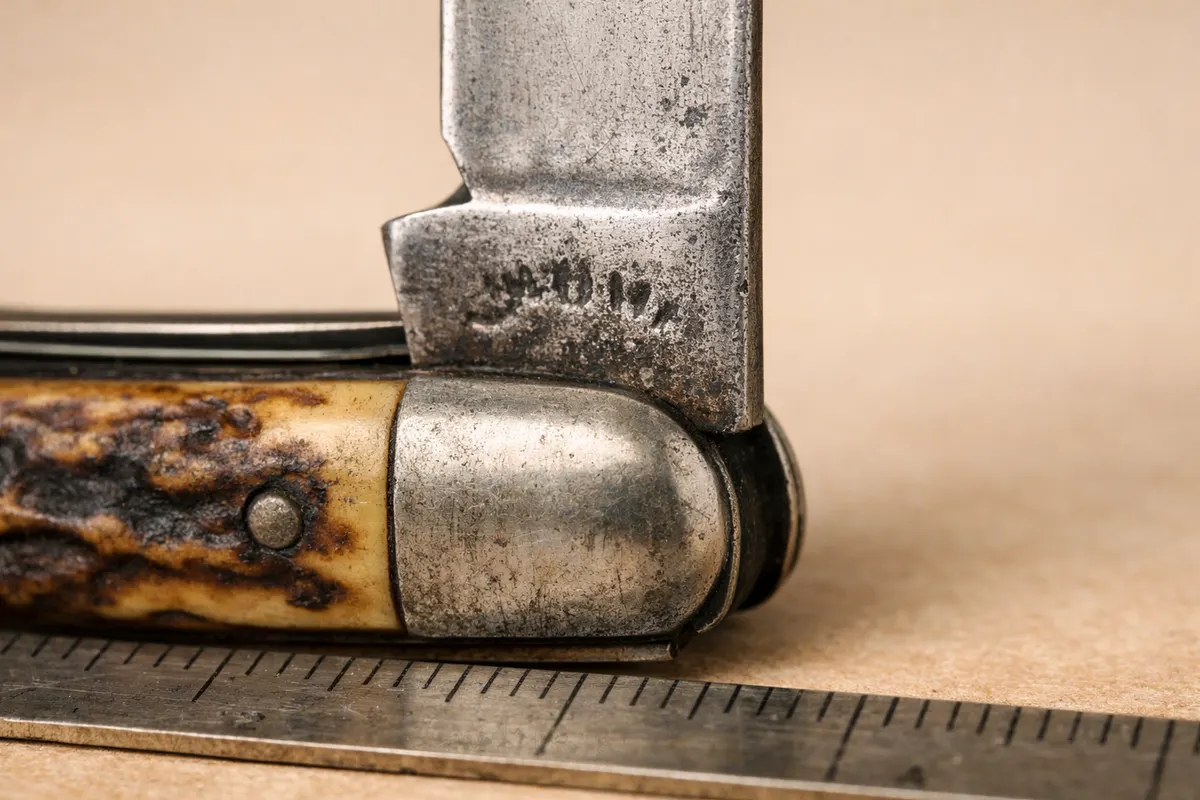
Quick answer: what a photo can show about an antique pocket knife
Antique pocket knife identification starts with what a clear photo can actually prove. A good image of the tang stamp, both blade flats, and the handle surfaces can reliably show a maker mark, a dot or letter dating mark (for specific makers), visible pattern details, and whether hardware or scales are later replacements. These visual clues are the strongest immediate evidence when you have only a photograph to work from.
That said, a photo rarely proves final authenticity or value by itself. Surface corrosion, later-stamped blades, and professional rehandles can all mimic original features in photographs. Treat a single image as a hypothesis that needs corroboration: transcribe stamps exactly as they appear, check both sides of the blade and tangs, and document construction features like liners, pins, and nail nicks before drawing a conclusion.
For readers who want a worked example, the Case Knowledge Base tang-stamp resources and dot-dating guides illustrate how one maker organizes its marks; use them as a model for how to read stamps, but apply maker-specific dating rules only to that maker. If you plan to continue with a photo-first workflow, consider an optional first-pass app check at https://antiqueidentifierbypicture.app/tools/antique-identifier after you finish the steps below.
- Start by photographing both blades open and closed, the tang heel stamp, and the handle from both faces.
- Transcribe the tang stamp exactly — spacing, punctuation, and any dots or letters matter.
- Use construction clues (pins, liners, end caps) to detect replacements that a tang stamp alone can't reveal.
What tang stamps, patterns, and construction tell you
Tang stamps are the easiest visible shorthand for attribution because they were applied at the factory and often include a maker name, location, or logo. On many knives the tang stamp sits low on the blade near the heel; on multi-blade knives you may find different stamps on each blade. Transcribing a tang stamp word-for-word — including punctuation, dots, and letter case — allows you to compare the exact mark to published manufacturer references or online databases.
Patterns and blade shapes (for example Barlow, Congress, Wharncliffe, or pen blades) show what model family the knife belongs to. Pattern names are useful because many makers produced characteristic lineups of patterns for decades; matching a pattern narrows the candidate list dramatically. Handle materials — stag, bone, celluloid, plastic composites, or mother-of-pearl — provide another cross-check because particular materials and finishes align with specific historical periods and makers.
Construction clues include the presence or absence of liners, the way pins are peened or filed, nail nicks and bolsters, and the fit between blade tang and handle scales. A rehandled knife often shows gaps, mismatched pin types, or modern adhesives at scale edges. Together, tang stamps, pattern forms, handle material, and construction give a documented chain of evidence: none is conclusive alone, but together they make a defensible attribution or raise red flags requiring further verification.
Key visual clues to check on a pocket knife
When you examine a photograph for antique pocket knife identification, prioritize images that show: the tang heel where stamps usually sit; both blade flats from spine to edge; the handle faces and ends; and the inside of the knife if possible (to reveal liners or stuck-open blades). Lighting should be oblique to show shallow stamped letters and dot impressions clearly, and include a scale or ruler so measurements can be checked afterwards.
Record the context: seller notes, provenance, any maker paperwork, and where the knife was acquired. Provenance that includes consistent photographs over time, or a named prior owner with verifiable records, raises confidence. If the seller claims the knife is unaltered, verify that claim by looking for inconsistent patina between blades and handle, replaced pins, or fresh tool marks indicative of re-work.
Check these specific visible clues carefully:
bullets:[
Exact tang stamp transcription: copy every character and spacing as seen.
Dot positions and single-character codes (for example, dots or letters) used by some makers to date production.
Blade-to-handle fit and peen style on pins — peened pins can be period-correct, modern flush pins may indicate repair.
Bolster wear and scalloping patterns that match expected use for era and maker.
Handle material grain and drill patterns — celluloid, early plastics, bone, and stag show different aging behavior.
Blade grind and steel type clues (visible temper lines, stamped steel names) that match published maker specs.
Inner liners, backsprings, and nail-nicks that reveal original construction vs rework.
Scale separation or fresh adhesive traces that indicate a rehandle or replacement scales.
Serial numbers, patent dates, or location marks in the tang stamp that point to manufacturer records.
old knife identification marks — look for specific letter shapes or punctuation quirks that match reference scans.
Step-by-step photo-first workflow for identification
1) Photograph deliberately. Take multiple high-resolution images: the obverse and reverse of the closed knife, each blade fully open showing the tang heel, the handle faces, the spine, the inside (if accessible), and any sheaths or boxes. Include a small ruler or coin for scale and use side lighting to reveal shallow stamps.
2) Transcribe marks exactly. Create a short log for the knife and type the tang stamp text exactly as it appears, noting punctuation, dots, and any damage that obscures letters. If the stamp appears different on each blade, transcribe each separately; differences can indicate re-blading or later replacement.
3) Compare pattern and construction. Match blade shapes and handle outlines to pattern plates or catalog images. Measure blade length and handle length if possible; many pattern references list dimension ranges that exclude lookalikes.
4) Cross-check maker-specific dating rules. Consult authoritative references for the maker in question. For example, the Case tang-stamp and dot-dating systems are documented in the Case Knowledge Base and show how letters and dots map to periods — use those rules only for Case knives. Do not apply Case dot-dating rules to other makers.
5) Look for inconsistency signals. If the tang stamp and the hardware style don’t match (for example, a modern-style flush pin with an old-styled stamped tang), that is a red flag for replacement parts or later rework.
6) Use reference resources. Search published maker catalog scans, museum collections, and collector forums. When you find a strong match, collect the source images and note the URL or citation so you can show the provenance of your conclusion.
7) Decide next-step verification. If the photo evidence is strong and provenance exists, a purchase or deeper appraisal may be reasonable. If uncertainty remains, arrange an in-person inspection with a reputable dealer or appraiser, or use an optional first-pass photo-check tool like the Antique Identifier page at https://antiqueidentifierbypicture.app/tools/antique-identifier to surface similar reference images quickly.
- Photograph both tang heels; some makers stamp only one blade.
- Transcribe and date only when you have a maker-specific reference for dating marks.
- Document any seller claims and ask for close-ups of suspicious joins or pins.
Worked examples: Case tang-stamps and common pattern checks
Worked examples sharpen the method. Case provides clear public guidance for reading tang stamps and dot dating; their Knowledge Base shows sample tang-stamp variants and explains how dots or letters were used to indicate production eras. For a photographed Case knife, transcribe the tang exactly, then consult the Case tang-stamps reference (https://kb.caseknives.com/tang-stamps) and dot-dating page (https://kb.caseknives.com/dot-dating). When the stamp matches a documented Case stamp and the dot/date logic fits, that increases confidence — but only for Case knives. Do not generalize Case dating rules to other manufacturers.
Example 1 — Clear Case match: a six-inch single-blade knife with a readable Case tang stamp and a dot pattern consistent with the Case dot chart. In that scenario the tang transcription, pattern match, and consistent aging of bone scales provide a strong attribution; still check for replaced pins or a rehandle before valuing the piece.
Example 2 — Partial match with replacement scales: a factory tang stamp matches a known maker, but the handle scales are modern composite with fresh adhesive at the seams. The tang proves the blade’s origin but not that the knife’s overall finish is original — the documented chain is therefore mixed and needs disclosure if sold.
Example 3 — False confidence from an added stamp: modern makers and forgers sometimes re-stamp blades to mimic a desirable maker. If stamping looks unusually crisp compared with wear elsewhere, or if the stamp style is anachronistic relative to expected pattern timelines, treat the mark as suspect and seek a metal/hardness test or in-person inspection. Photographs can detect many of these clues but cannot always disprove a skilled re-stamp.
- Case worked example: transcribe the tang stamp, check the dot pattern on the Case dot-dating page, and confirm handle material and pins align with the same era.
- When a tang stamp matches but construction doesn’t, report a mixed-origin conclusion rather than a full factory-original claim.
- If a stamp appears too crisp, request additional photos of the tang heel, the inside of the knife, and any known provenance documentation.
Limitations
Photographs have important limitations. A photo cannot reliably confirm metallurgy, tempering, or microscopic tool marks that expert authenticators use. It also cannot detect some kinds of tampering: a professional rehandle or re-stamping can be convincing in images, and a seller can omit or misrepresent damage. For valuation you need condition-grade consensus and recent sale comparables — photos alone are rarely sufficient for a firm market price.
Value and authenticity claims tied to maker-specific dating systems require source verification. Use the Case Knowledge Base only for Case products; many makers did not use the same dot or letter systems. When a maker has no published dating chart, avoid definitive year claims and instead describe evidence by level of confidence (high, probable, uncertain).
When to get in-person verification: if the knife is rare, high-value, shows inconsistent construction clues, or will be used as a resale or bequest asset, arrange a hands-on inspection. A qualified appraiser can open the knife, test for soldered or peened pins, perform metallurgical analyses if needed, and compare serial or patent marks to manufacturer archives. If the seller’s provenance is essential to the price, request original paperwork or documented chain-of-custody photos before relying on the image-based attribution.
- Separate what a photo suggests (maker, pattern, likely era) from what it proves (metal composition, absolute originality).
- Use maker-specific references only for that maker; Case dot-dating applies to Case knives alone.
- Seek an in-person expert when provenance affects price or when construction clues are ambiguous.
Related guides
Next step: an optional first-pass photo check
If you want a fast, photo-first check after you’ve documented stamps and construction, consider Antique Identifier’s optional first-pass tool at https://antiqueidentifierbypicture.app/tools/antique-identifier. Use it to surface visual reference matches and known mark images quickly, then follow up with maker references or an in-person inspection for high-value or uncertain cases. For guidance on reading other kinds of marks, the site’s Antique Silver Marks guide demonstrates similar mark-transcription methods: https://antiqueidentifierbypicture.app/blog/antique-silver-marks.
Take the next step →Frequently asked questions
How can I do vintage pocket knife identification when buying a knife online?
When buying online, start with high-resolution photos that show both blade tangs, each blade fully open, and all sides of the handle. Transcribe any stamps exactly and compare them to maker references. Ask the seller for close-ups of pins, tang heels, and the inside of the knife to check for rehandles or replaced scales. Use pattern plates to match blade shapes and measure dimensions from photos where possible. If the knife is potentially valuable, treat the photo evidence as provisional and arrange an in-person inspection with a reputable dealer or appraiser before completing a high-value purchase.
What do tang stamps tell me about age and maker on an antique pocket knife?
Tang stamps identify a manufacturer or brand, and sometimes include location, patent dates, or maker logos. They are a primary attribution clue because they were added at the factory; copying the stamp exactly lets you search catalogs and maker databases for matches. Some makers also used dot or letter systems to indicate production eras, but those date codes are maker-specific and should only be used with an authoritative reference. Tang stamps are strong evidence when supported by pattern, handle material, and consistent wear.
How can I tell if a pocket knife has replacement parts or a rehandle from photos?
Look for mismatched patina, different pin styles, fresh adhesives at scale seams, or gaps where scales meet liners. Modern flush pins, inconsistent file-work on bolsters, or nail-nicks that don’t line up between open and closed blades are red flags. Inside photos that show liners, backsprings, and tang shoulders help confirm original construction. If photos are inconclusive, request in-person inspection or ask for a video of the knife being opened and closed to watch for mechanical inconsistencies.
When should I get a professional verification or appraisal for a collectible pocket knife?
Seek professional verification when provenance affects value, the knife is rare or unusually fine, or when photo-based evidence leaves ambiguous or conflicting clues. Also consult an appraiser if you plan to insure, sell at auction, or include the knife in an estate. A specialist can open the knife safely, test pins and steels, and consult maker archives or serial records to confirm dating and maker claims.